This article updates the complete example that originally lived on
the gh-pages branch. It follows a game from its initial
position through move history, FEN and PGN loading, game-state
validation, and visualization.
Start a game
Create a game in the standard starting position and inspect its legal moves:
game <- Chess$new()
game$moves()
#>  [1] "a3"  "a4"  "b3"  "b4"  "c3"  "c4"  "d3"  "d4"  "e3"  "e4"  "f3"  "f4"
#> [13] "g3"  "g4"  "h3"  "h4"  "Na3" "Nc3" "Nf3" "Nh3"
game$moves(verbose = TRUE)
#> # A tibble: 20 × 6
#>    color from  to    flags piece san
#>    <chr> <chr> <chr> <chr> <chr> <chr>
#>  1 w     a2    a3    n     p     a3
#>  2 w     a2    a4    b     p     a4
#>  3 w     b2    b3    n     p     b3
#>  4 w     b2    b4    b     p     b4
#>  5 w     c2    c3    n     p     c3
#>  6 w     c2    c4    b     p     c4
#>  7 w     d2    d3    n     p     d3
#>  8 w     d2    d4    b     p     d4
#>  9 w     e2    e3    n     p     e3
#> 10 w     e2    e4    b     p     e4
#> 11 w     f2    f3    n     p     f3
#> 12 w     f2    f4    b     p     f4
#> 13 w     g2    g3    n     p     g3
#> 14 w     g2    g4    b     p     g4
#> 15 w     h2    h3    n     p     h3
#> 16 w     h2    h4    b     p     h4
#> 17 w     b1    a3    n     n     Na3
#> 18 w     b1    c3    n     n     Nc3
#> 19 w     g1    f3    n     n     Nf3
#> 20 w     g1    h3    n     n     Nh3
Moves use Standard Algebraic Notation and can be chained:
game$move("e4")$move("e5")$move("Nf3")$move("Nc6")
game$history()
#> [1] "e4"  "e5"  "Nf3" "Nc6"
game$history(verbose = TRUE)
#> # A tibble: 4 × 7
#>   color from  to    flags piece san   number_move
#>   <chr> <chr> <chr> <chr> <chr> <chr>       <int>
#> 1 w     e2    e4    b     p     e4              1
#> 2 b     e7    e5    b     p     e5              2
#> 3 w     g1    f3    n     n     Nf3             3
#> 4 b     b8    c6    n     n     Nc6             4
Inspect the current position and active side:
game$turn()
#> [1] "w"
game$fen()
#> [1] "r1bqkbnr/pppp1ppp/2n5/4p3/4P3/5N2/PPPP1PPP/RNBQKB1R w KQkq - 2 3"
game$get("e4")
#> $type
#> [1] "p"
#>
#> $color
#> [1] "w"
game$square_color("h1")
#> [1] "light"
Undo the latest move or print the board in the console:
game$undo()
#> $color
#> [1] "b"
#>
#> $from
#> [1] "b8"
#>
#> $to
#> [1] "c6"
#>
#> $flags
#> [1] "n"
#>
#> $piece
#> [1] "n"
#>
#> $san
#> [1] "Nc6"
game$ascii()
#>    +------------------------+
#>  8 | r  n  b  q  k  b  n  r |
#>  7 | p  p  p  p  .  p  p  p |
#>  6 | .  .  .  .  .  .  .  . |
#>  5 | .  .  .  .  p  .  .  . |
#>  4 | .  .  .  .  P  .  .  . |
#>  3 | .  .  .  .  .  N  .  . |
#>  2 | P  P  P  P  .  P  P  P |
#>  1 | R  N  B  Q  K  B  .  R |
#>    +------------------------+
#>      a  b  c  d  e  f  g  h
Render the board
plot() returns an interactive chessboard.js widget by
default:
plot(game)Use type = "ggplot" for a static ggplot2 board:
plot(game, type = "ggplot")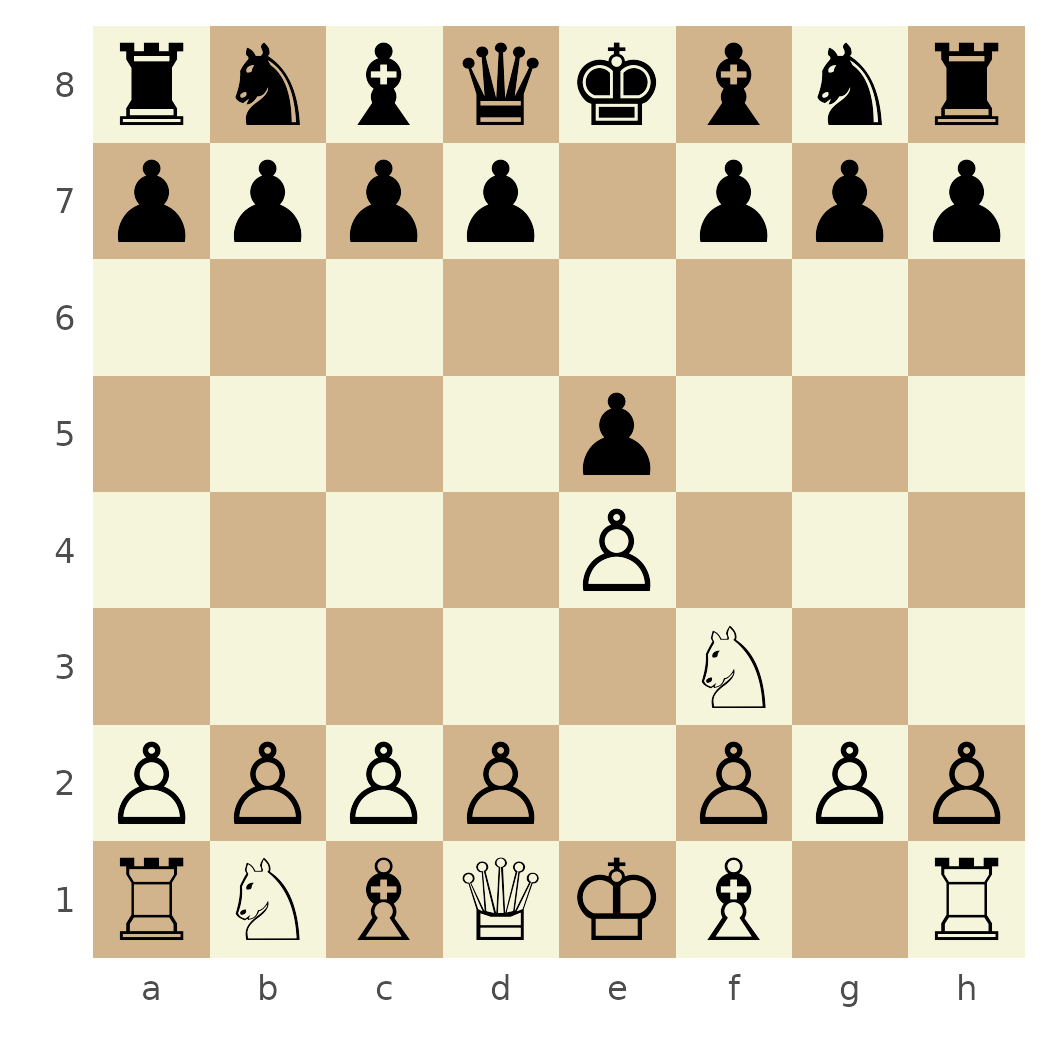
You can also render any FEN position directly:
fen <- "rnbqkbnr/pp1ppppp/8/2p5/4P3/8/PPPP1PPP/RNBQKBNR w KQkq c6 0 2"
ggchessboard(fen, perspective = "black")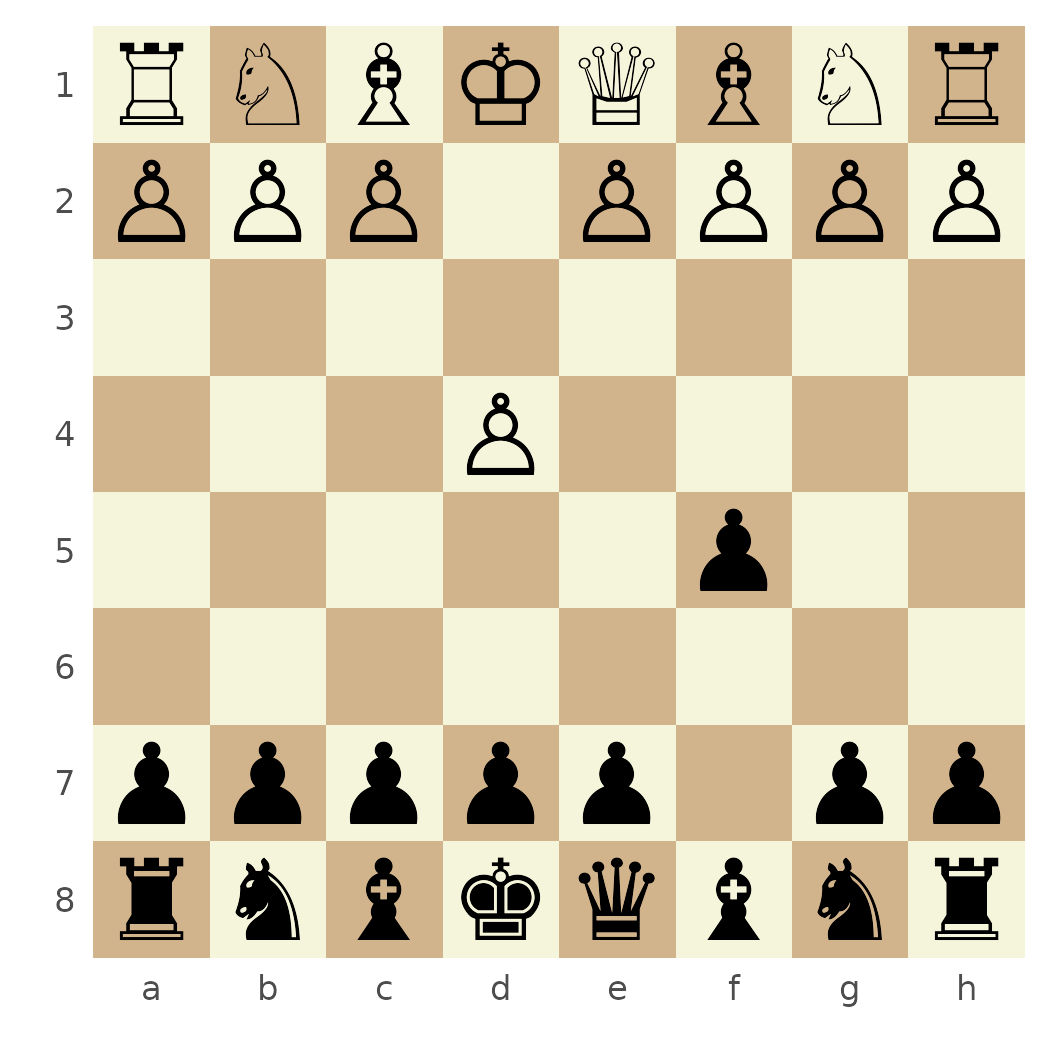
Load FEN positions
Create a game from FEN or replace the position of an existing game:
fen_game <- Chess$new(fen)
fen_game$turn()
#> [1] "w"
fen_game$moves()
#>  [1] "e5"  "a3"  "a4"  "b3"  "b4"  "c3"  "c4"  "d3"  "d4"  "f3"  "f4"  "g3"
#> [13] "g4"  "h3"  "h4"  "Na3" "Nc3" "Qe2" "Qf3" "Qg4" "Qh5" "Ke2" "Be2" "Bd3"
#> [25] "Bc4" "Bb5" "Ba6" "Ne2" "Nf3" "Nh3"

fen_game$load("4k3/4P3/4K3/8/8/8/8/8 b - - 0 78")
#> [1] TRUE
fen_game$in_stalemate()
#> [1] TRUE
Load PGN games
The package includes the famous Kasparov–Topalov game from Wijk aan Zee 1999:
pgn_path <- system.file(
  "extdata/pgn/kasparov_vs_topalov.pgn",
  package = "rchess"
)
pgn <- paste(readLines(pgn_path, warn = FALSE), collapse = "\n")

pgn_game <- Chess$new()
pgn_game$load_pgn(pgn)
#> [1] TRUE
pgn_game$get_header()
#> $Event
#> [1] "Hoogovens A Tournament"
#>
#> $Site
#> [1] "Wijk aan Zee NED"
#>
#> $Date
#> [1] "1999.01.20"
#>
#> $EventDate
#> [1] "?"
#>
#> $Round
#> [1] "4"
#>
#> $Result
#> [1] "1-0"
#>
#> $White
#> [1] "Garry Kasparov"
#>
#> $Black
#> [1] "Veselin Topalov"
#>
#> $ECO
#> [1] "B06"
#>
#> $WhiteElo
#> [1] "2812"
#>
#> $BlackElo
#> [1] "2700"
#>
#> $PlyCount
#> [1] "87"
head(pgn_game$history(verbose = TRUE))
#> # A tibble: 6 × 8
#>   color from  to    flags piece san   captured number_move
#>   <chr> <chr> <chr> <chr> <chr> <chr> <chr>          <int>
#> 1 w     e2    e4    b     p     e4    NA                 1
#> 2 b     d7    d6    n     p     d6    NA                 2
#> 3 w     d2    d4    b     p     d4    NA                 3
#> 4 b     g8    f6    n     n     Nf6   NA                 4
#> 5 w     b1    c3    n     n     Nc3   NA                 5
#> 6 b     g7    g6    n     p     g6    NA                 6
Detailed history follows each original piece through the game and records captures:
detail <- pgn_game$history_detail()
detail
#> # A tibble: 88 × 8
#>    piece    from  to    number_move piece_number_move status number_move_capture
#>    <chr>    <chr> <chr>       <int>             <int> <chr>                <int>
#>  1 a1 Rook  a1    d1             21                 1 NA                      NA
#>  2 a1 Rook  d1    d4             29                 2 NA                      NA
#>  3 a1 Rook  d4    d1             31                 3 NA                      NA
#>  4 a1 Rook  d1    d4             47                 4 captu…                  48
#>  5 b1 Knig… b1    c3              5                 1 NA                      NA
#>  6 b1 Knig… c3    d5             43                 2 captu…                  44
#>  7 c1 Bish… c1    e3              7                 1 NA                      NA
#>  8 c1 Bish… e3    h6             15                 2 captu…                  16
#>  9 White Q… d1    d2              9                 1 NA                      NA
#> 10 White Q… d2    h6             17                 2 NA                      NA
#> # ℹ 78 more rows
#> # ℹ 1 more variable: captured_by <chr>
Add PGN metadata
Headers can be added before exporting a game:
annotated <- Chess$new()
annotated$move("e4")$move("e5")
annotated$header("White", "Player One")
annotated$header("Black", "Player Two")
annotated$header("Site", "R session")
annotated$get_header()
#> $White
#> [1] "Player One"
#>
#> $Black
#> [1] "Player Two"
#>
#> $Site
#> [1] "R session"
cat(annotated$pgn())
#> [White "Player One"]
#> [Black "Player Two"]
#> [Site "R session"]
#>
#> 1. e4 e5
Validate game state
Checkmate:
mate <- Chess$new(
  "rnb1kbnr/pppp1ppp/8/4p3/5PPq/8/PPPPP2P/RNBQKBNR w KQkq - 1 3"
)
mate$in_check()
#> [1] TRUE
mate$in_checkmate()
#> [1] TRUE
Threefold repetition:
repetition <- Chess$new()
repetition$move("Nf3")$move("Nf6")$move("Ng1")$move("Ng8")
repetition$move("Nf3")$move("Nf6")$move("Ng1")$move("Ng8")
repetition$in_threefold_repetition()
#> [1] TRUE
Insufficient material:
material <- Chess$new("k7/8/n7/8/8/8/8/7K b - - 0 1")
material$insufficient_material()
#> [1] TRUE
Included data
rchess includes opening classifications and FIDE World
Cup games:
data("chessopenings", package = "rchess")
data("chesswc", package = "rchess")

head(chessopenings)
#> # A tibble: 6 × 4
#>   eco   name              variant                   pgn
#>   <chr> <chr>             <chr>                     <chr>
#> 1 A01   Irregular Opening Nimzowitsch-Larsen Attack 1. b3
#> 2 A02   Bird's Opening    Bird's Opening            1. f4
#> 3 A03   Bird's Opening    Bird's Opening            1. f4 d5
#> 4 A04   Irregular Opening Reti Opening              1. Nf3
#> 5 A05   Irregular Opening Reti Opening              1. Nf3 Nf6
#> 6 A06   Irregular Opening Reti Opening              1. Nf3 d5
dplyr::count(chesswc, event)
#> # A tibble: 3 × 2
#>   event                   n
#>   <chr>               <int>
#> 1 FIDE World Cup 2011   398
#> 2 FIDE World Cup 2013   435
#> 3 FIDE World Cup 2015   433